UK Preferred Partner for Movex®

Norfolk-Based Plastic Finishing Specialists
Plastic Polishing & Finishing Services UK
In-house flame polishing, edge finishing and bonding of CNC-machined acrylic, Perspex® and engineering plastic components. Specialists in industrial-grade polished finishes for conveyor parts, machine guards, exhibition equipment and visual production-line components.
5
Polishing Techniques
Mirror
Edge Finish Quality
In-House
No Subcontracting
1991
Established
Our Polishing & Finishing Capability
Industrial-Grade Plastic Finishing, In-House
SL Plastics offers comprehensive in-house polishing and edge finishing services for plastic components, with a particular focus on industrial applications where appearance matters as much as function. Whether you need flame-polished roll guides for labelling equipment, diamond-finished display panels for exhibition machinery, or simply a clean machined edge for a machine guard, we handle it in our Norfolk workshop.
Unlike POS and retail-display polishing specialists, we understand the demands of industrial production environments, where polished components also need to perform reliably under mechanical load, washdown conditions and continuous operation. Our finishing services are typically combined with our CNC machining service so customers receive a complete, finished part ready for installation.
Our Polishing Techniques
Five Finishing Techniques, One UK Supplier
Different parts and finishes call for different techniques. We offer the full range in-house, so you receive a single finished component rather than dealing with multiple subcontractors.
OUR HEADLINE TECHNIQUE
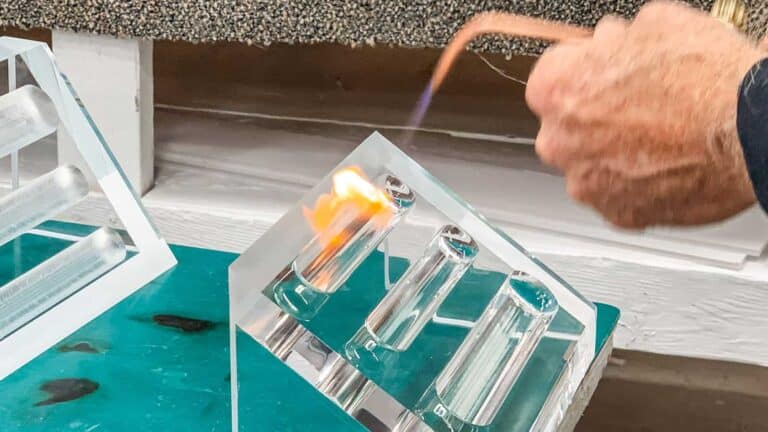
Flame Polishing
Acrylic / Perspex® / PMMA
When to use: Curved or irregular edges, awkward shapes, intricate geometry where diamond polishing cannot reach. Ideal for parts with complex profiles.
Best for: Roll guides on labelling equipment, exhibition machine components, bespoke industrial parts where machined surfaces need a mirror-like edge finish.
POLISHING TECHNIQUE
Diamond Polishing
Acrylic / PETG / Polycarbonate
When to use: Straight edges on flat sheet plastic components. Produces an optically clear, glass-like finish ideal for visible edges.
Best for: Display panels, sight glasses, inspection windows and any plastic component where edge clarity needs to be uniform and pristine across long runs.
POLISHING TECHNIQUE
Hand Buffing & Polishing
All thermoplastics
When to use: Final-pass polishing after diamond or flame work, or for one-off custom parts where machine polishing isn't appropriate due to size or geometry.
Best for: Bespoke industrial components, prototypes, and small-batch work where the final finish needs individual operator attention.
POLISHING TECHNIQUE
Edge Finishing & Deburring
All machined plastics
When to use: Standard finish on every CNC-machined part to remove burrs, sharp edges and machining marks. Included as standard with all our CNC work.
Best for: Machine guards, structural conveyor parts, and any component where clean, safe edges matter more than visual perfection.
POLISHING TECHNIQUE
Plastic Bonding & Welding
Solvent / adhesive bonding
When to use: Joining two or more plastic components into a single fabricated assembly. Most often paired with polished edges for a finished look.
Best for: Custom display assemblies, fabricated machine covers, multi-part guards, and any plastic fabrication requiring permanent joints.
Need a different finish?
We can also handle sanding, chamfering, drilling, tapping and threaded insert installation as part of a complete finished part. Most CNC-machined parts arrive ready for direct installation.
View CNC Services →Not sure which technique is right for your part? Send us your drawing or photo and we’ll recommend the best finishing approach for your application and budget.
Materials We Polish & Finish
Engineering Plastics for Polished Finishes
Acrylic / Perspex® (PMMA) is our primary polishing material. Acrylic responds exceptionally well to both flame and diamond polishing techniques, producing the mirror-like edge finishes that make it the go-to material for visual industrial components such as roll guides, sight glasses and exhibition equipment.
PETG and Polycarbonate can be diamond polished for a clear edge finish, though they don’t take to flame polishing as cleanly as acrylic does. We typically recommend diamond polishing for these materials when edge clarity is required.
Other engineering plastics (Nylon, Acetal, UHMW-PE, HDPE) can be edge-finished and deburred as part of standard CNC work but don’t take a true polished finish. Best for functional parts where edge appearance matters less than mechanical performance.
Material / Technique Match
| Acrylic | Flame + Diamond |
| Perspex® | Flame + Diamond |
| PETG | Diamond |
| Polycarbonate | Diamond |
| Nylon | Edge finish only |
| Acetal | Edge finish only |
| UHMW-PE | Edge finish only |
Industries We Serve
Industrial Polishing, Not Retail Display
Most UK plastic polishing specialists focus on point-of-sale, retail displays and exhibition fittings. We focus on industrial applications where polished components also need to perform reliably in production environments.
Labelling Equipment
Flame-polished Perspex® roll guides for high-speed bottling and labelling lines, where smooth edges prevent label snags and the polished finish reads as a quality detail to plant managers.
Exhibition Machinery
Bespoke polished components for exhibition machines and demonstration equipment, where visual quality is critical because the equipment is sold partly on appearance as well as performance.
Machine Guarding
Edge-finished and bonded guard panels in clear acrylic, PETG and polycarbonate, polished where visibility and aesthetics matter, deburred where function alone is required.
Conveyor Components
Polished and finished conveyor parts including side guides, transfer plates and inspection windows, where smooth edges affect product flow and equipment longevity.
Quality, Lead Times & How We Quote
What Buyers Need to Know
Lead Times
Polishing and finishing is typically completed as part of CNC machining, with combined lead times of 1 to 2 weeks. Polishing-only work on customer-supplied parts is usually faster on enquiry.
Order Quantities
No minimum quantity. We polish one-off prototypes and bespoke parts as readily as production runs, with pricing reflecting batch efficiency.
Inspection
Every polished part is visually inspected before despatch. For high-value visible components we provide photographs prior to despatch on request.
Frequently Asked Questions
Plastic Polishing Questions Answered
What is flame polishing?
Flame polishing is a finishing technique where a controlled gas flame is briefly applied to the machined edge of an acrylic or Perspex® component. The flame melts the surface layer just enough for surface tension to smooth the edge into a glass-like mirror finish. It works best on curved or irregular edges where diamond polishing cannot reach, and is particularly common on industrial components where machined surfaces need a polished appearance.
What's the difference between flame and diamond polishing?
Diamond polishing uses a precision diamond-tipped machine to grind the edge to optical clarity, ideal for straight edges on flat sheet plastic. Flame polishing uses a controlled flame to melt the surface layer, ideal for curved, irregular or hard-to-reach edges. Most plastic polishing jobs use one or the other depending on the part geometry. Some parts use both: diamond polishing on the straight edges, flame polishing on the curves.
What materials can you flame polish?
Acrylic (also known as Perspex® or PMMA) is the ideal material for flame polishing. The technique doesn’t work well on PETG or polycarbonate, where diamond polishing produces a better result. For other engineering plastics (Nylon, Acetal, UHMW-PE) we offer edge finishing and deburring as standard with CNC machining, but a true polished finish isn’t achievable on these materials.
Do you polish customer-supplied parts?
Yes. While most of our polishing is done on parts we have CNC machined ourselves (so we know the material spec, tolerance and edge condition), we can also polish customer-supplied parts on enquiry. Send us a sample or photographs and we can advise on what finish is achievable and what it would cost.
Is polishing always required on machined acrylic?
Not always. For visible components such as roll guides on labelling equipment, sight glasses, exhibition machine parts or decorative covers, polishing dramatically improves appearance. For internal or hidden components where appearance doesn’t matter, a clean machined edge with deburring is often perfectly suitable and saves the cost of polishing.
What is your typical lead time?
When polishing is part of a complete CNC machining job, total lead times are typically 1 to 2 weeks. Polishing-only work on customer-supplied parts is usually faster, often within a few days depending on current workshop capacity. Urgent breakdown or rush work can often be accommodated on enquiry.
Where are you based and do you ship UK-wide?
We are based in Thetford, Norfolk and ship polished components UK-wide. Polished parts are packaged with extra protection to prevent edge damage during transit. International shipping is available on enquiry.
Ready to Quote Your Polishing Project?
Send us your drawings or describe your application. Our Norfolk-based team will recommend the right polishing technique, lead time and pricing the same working day.
